It’s a new year, and Signals has a new look. Check out the app to see our sleek new design and sample Publisher Dashboard.
Alongside many UI improvements, we have been busy developing many new capabilities for Signals Manuscript Checks and the Publisher Dashboard. The updates will help our Publisher partners improve their screening of all submissions for potential research integrity issues, and their ability to monitor research integrity trends across all journals in their portfolio.
Signals’ latest product update includes:
- Invalid references signal (such as references hallucinated by AI)
- A new view of all references in publications and manuscripts, and deeper reference analysis
- Publisher Dashboard Overview for monitoring trends in research integrity signals across journals
Invalid References Signal
We’re frequently asked whether Signals can detect hallucinated references in AI-generated manuscripts. Now it can — and more. This is a major update to Signals Manuscript Checks.
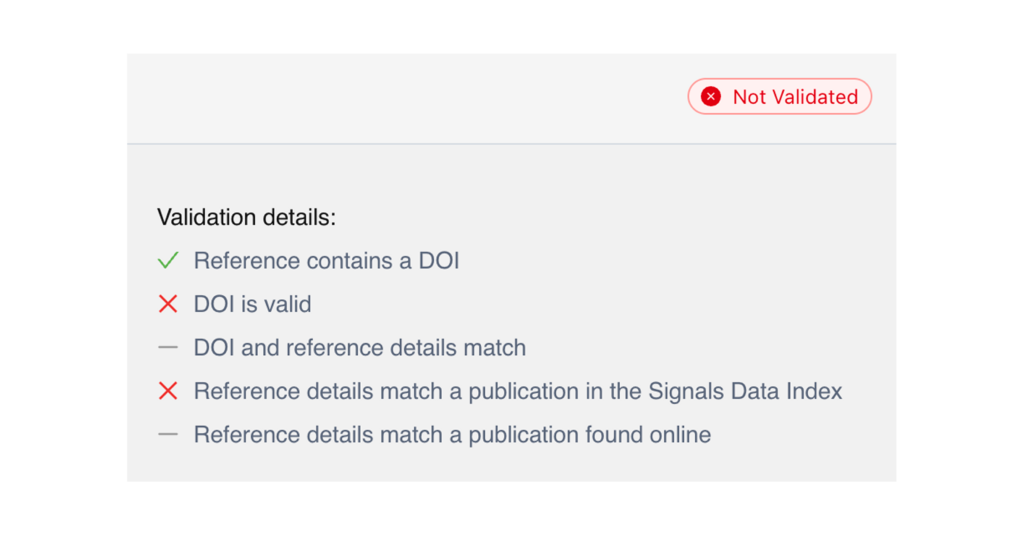
Signals now flags three types of invalid references, giving editors early and actionable indicators of potential error or misconduct.
References that cannot be resolved
The Signals Data Graph contains hundreds of millions of publications, providing a comprehensive view of the publication record. Through Signals Manuscript Checks, we try to map (i.e., resolve) each reference in the manuscript to a publication in the Signals Data Graph, which may provide crucial information for the manuscript evaluation. This is how we can, for example, identify retracted references or references for which there are known problems flagged by research integrity sleuths. However, some manuscripts include several references that cannot be matched to a publication within the Signals Data Graph, which often may be a sign that a reference is hallucinated by AI, or it is not indexed within industry-standard databases. Both cases are important for editors to identify early in the publishing process.

Invalid DOI
Similar to cases where a reference cannot be resolved, Signals Manuscript Checks can flag references with an invalid DOI, such as when the DOI is invalid or it does not point to a known publication in the Signals Data Graph. This could simply be an error that needs to be resolved, or could be a hallucinated DOI.
Metadata Mismatch
A third type of reference that cannot be validated is flagged when the reference DOI in the reference list does not match the associated metadata for that same reference. This can be a form of citation manipulation where authors cite an article that is not referenced in the text. Such cases may be an error, but it can also be an attempt to manipulate citation which editors and reviewers will find hard to detect. Identifying this type of reference is critical to ensure the correct article is cited and that citation metrics are not gamed.
These new signals will be available very soon to all publishers using Signals Manuscript Checks via ScholarOne, Editorial Manager, bespoke integrations, and Direct Upload.
A new view of references and deeper reference analysis
Signals analysis will now display the full reference list of analysed manuscripts and publications. For manuscripts, the reference list will include all validated and non-validated references, allowing editorial teams to assess reference quality and relevance across the entire manuscript, and become aware of potentially hallucinated or manipulated references.
We will also add the ability to see the age of each validated reference. This feature is often requested by editorial teams to evaluate how up-to-date a reference list is — this is particularly important in fast-moving fields.
Publisher dashboard overview for trend monitoring
The Journal Dashboard Overview lets you track trends and spikes in the evaluations of published articles over time, both at the overall evaluation level and for individual signals. Such trends can be very difficult to detect when analyzing articles in isolation, but can identify journals that are more vulnerable or that are under systematic attack by bad actors.
These early indicators help journal teams act quickly to protect their portfolio, avoid large-scale retractions, and delistings from indexes. The Journal Dashboard Overview enables publishers to shift from reactive to proactive research integrity management.
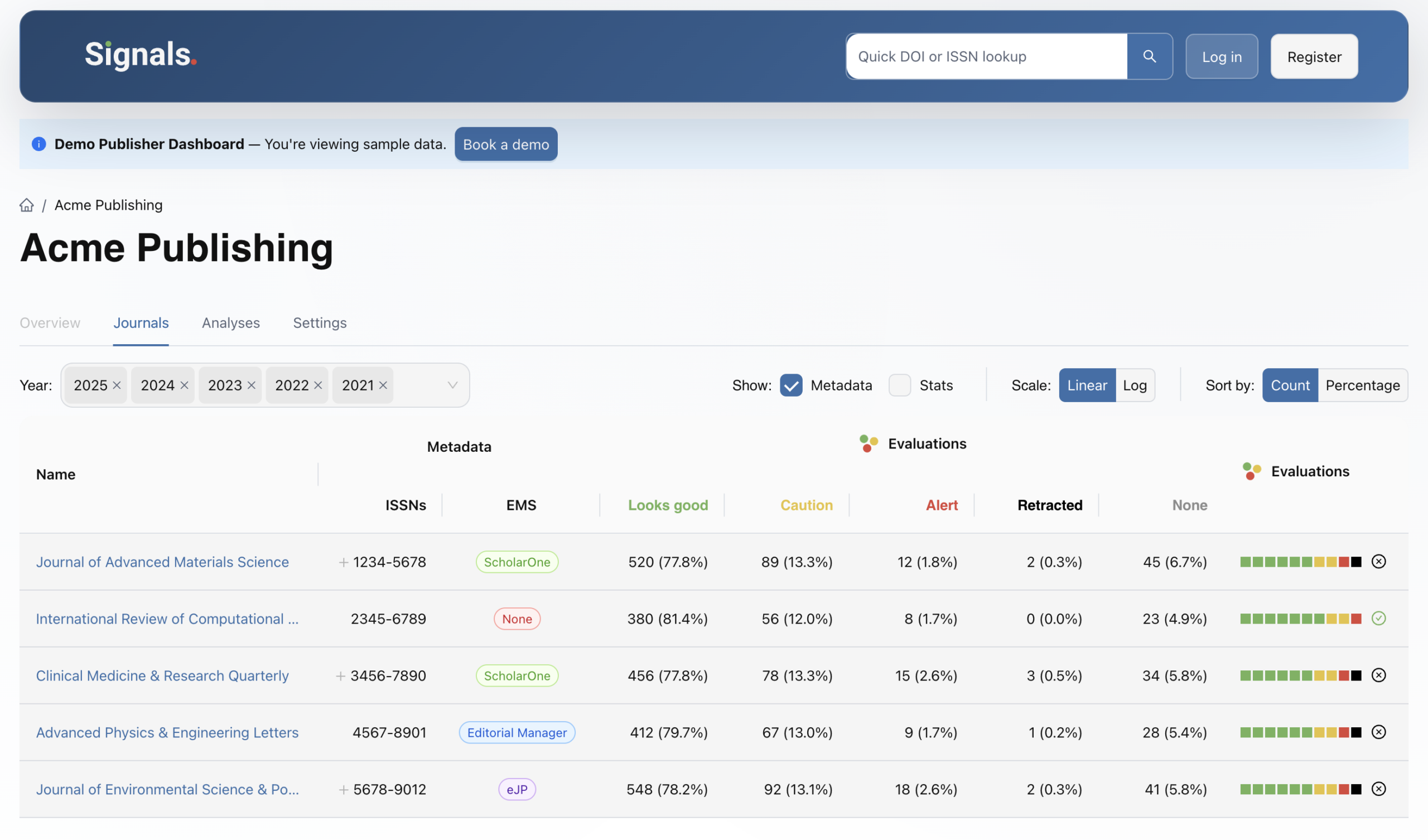
To learn more about the Journal Dashboard Overview, check out our new ‘Sample Dashboard’.
2026 will be a big year for research integrity, and we have very exciting plans for new features, integrations and products that we can’t wait to tell you more about.
Get in touch
Learn more about Signals and explore how we can support your research integrity strategy. You can:
Email us at hello@research-signals.com
Fill in our demo request form
Following us on LinkedIn