

Signals announces the release of curated Author Profiles as part of their Manuscript Checks product
With huge increases in submission volumes and an ever-expanding global author base, editorial teams are increasingly assessing submissions from researchers they have never previously encountered. This in itself is not an issue, however with a significant amount of fraudulent activity occurring, publishers need to validate all aspects of a manuscript, including the authors. Signals was already flagging potential concerns in an author’s publication record, but it didn’t capture all of their activities. Until today, building that fuller picture meant leaving the manuscript, searching several databases and assembling a picture by hand. This is time-consuming work that rarely yields a reliable or complete result.
This is why we’re excited to introduce Manuscript Author Profiles. Click any resolved author name on a Signals manuscript report and you get a profile page for that author, built from the Signals Data Graph.
What’s on the profile
The profile opens with a summary of the author’s record: how many publications we attribute to them, how often their work has been cited and how Signals has evaluated those publications. Because we have already analysed each of them, we can show a signals summary covering that whole body of work, so a pattern of signals is visible at a glance.
In addition, we show the author’s affiliation history and the publications themselves, with the detail needed to understand who they are, where their expertise lies and where they published in the past.
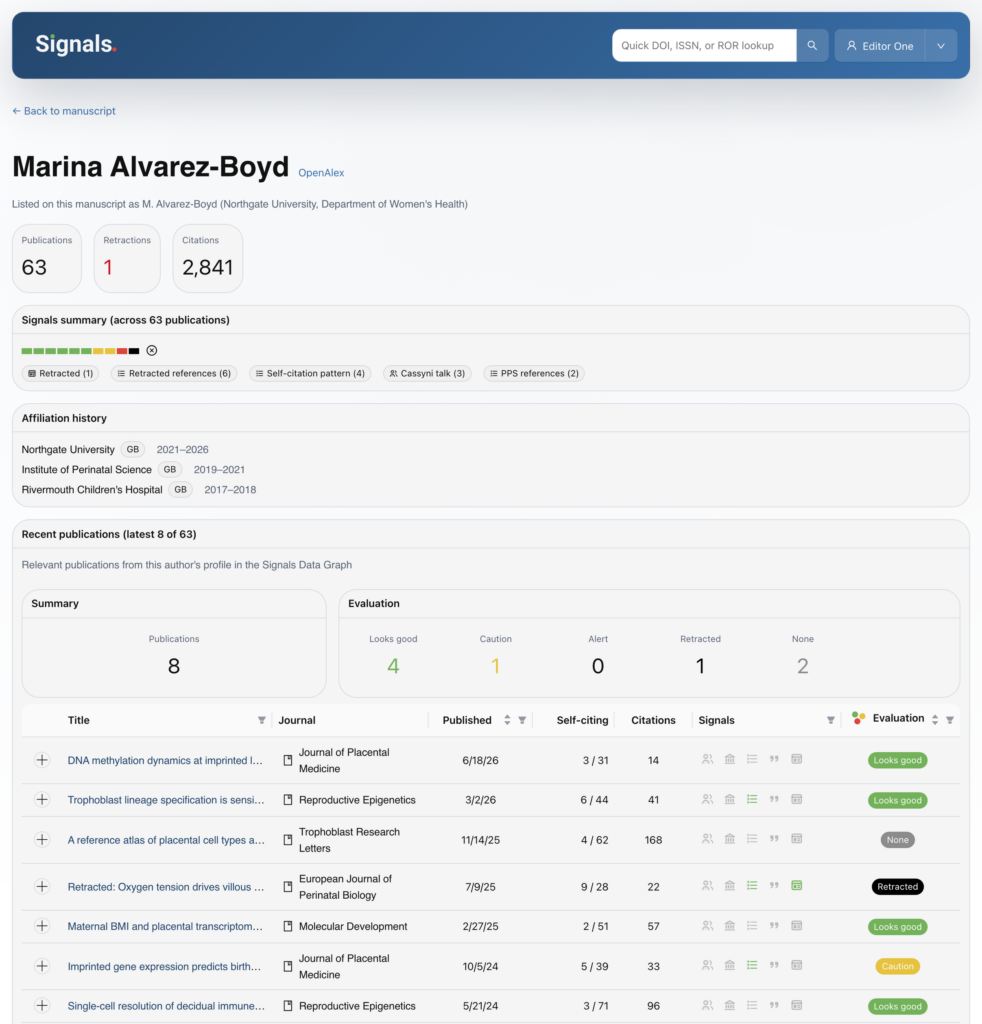
The always challenging author disambiguation problem
Building an author’s publication record may sound trivial, but it isn’t. Author disambiguation is hard and resolving authors correctly is what determines whether editors can trust the profile page.
Author records in the scholarly record are frequently conflated, with multiple researchers who share a name merged into a single identifier. In one record we examined, a developmental biologist, a medicinal chemist and an academic psychologist were combined under one widely used identifier. Seventy-three publications by the three individuals were all attributed to one profile. Using the Signals Data Graph, we could easily identify the fifteen publications belonging to the researcher on the manuscript. Matching on name alone would have put all seventy-three on their profile, and editors would rightly have stopped trusting it.
False positives are the expensive failure in research integrity tools. Once a team stops trusting the data or the product, they start verifying everything manually, the very inefficiency we set out to remove. A profile padded with someone else’s publications fails in exactly that way, creating extra work and eroding trust.
Where we are uncertain, we say so
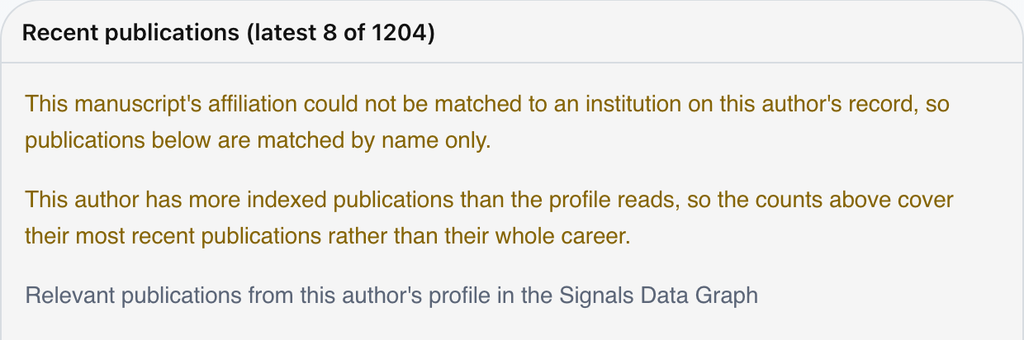
When we cannot resolve a manuscript author with high confidence, we say so on the page, so editors know those results are weaker. For unusually prolific authors we work through the most recent publications rather than an entire career, and again say so rather than present a partial count as a total.
Available now
Manuscript Author Profiles are available now to Signals Manuscript Checks customers. Author names on manuscript reports become links wherever we have been able to resolve the author, so that the profile is right there when it’s needed.
Signals began by surfacing what is wrong with a manuscript. Increasingly we are giving editors all the context they need to make informed decisions about each submission, from helping them catch problematic work to moving great research through to publication more quickly.
Book a demo to see how Signals Manuscript Checks can help your editorial teams make faster, better-founded decisions about authors they don’t know.
Get in touch
Learn more about Signals and explore how we can support your research integrity strategy. You can:
Email us at hello@research-signals.com
Fill in our demo request form
Follow us on LinkedIn