
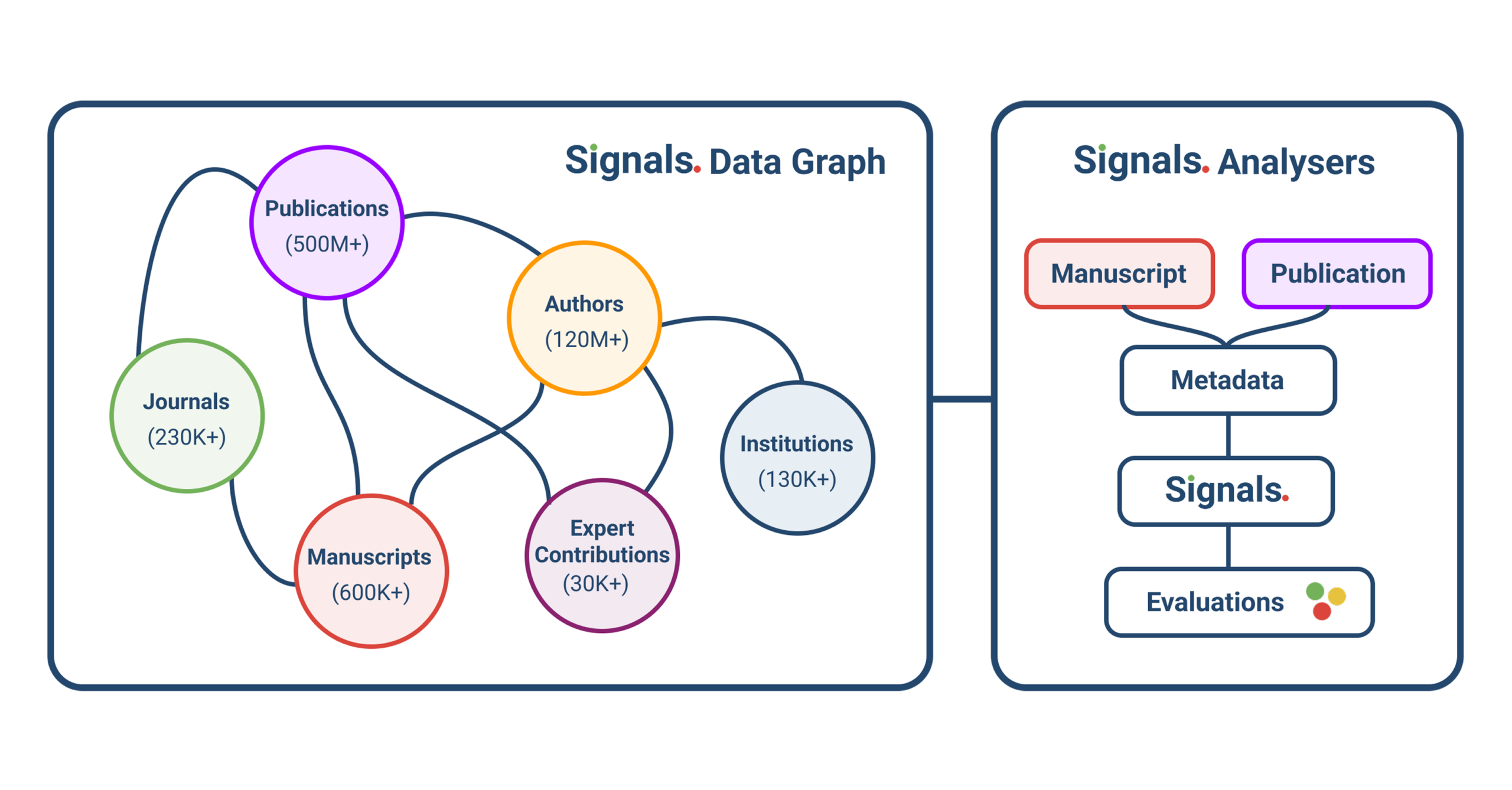
Sometimes the biggest changes happen behind the scenes. For Signals, that means a major upgrade to the underlying engine of our products — the Signals Data Graph (SDG).
For publishers this means a significant step forward in both the accuracy and contextual understanding of our manuscript checks as part of editorial workflows. It also enables us to expand our understanding of global publishing output and deliver new insights that enhance manuscript evaluation.
The SDG has been up and running for a couple of years. It combines curated public and proprietary data, with new connections and signals that provides a unique understanding of the scholarly record. Over the last two years it has been key to delivering reports to publishers that covered over 2 million publications and identified over 50,000 potentially problematic publications. Until now, the SDG has been used with specific products on a case by case basis.
That has now changed. We’ve released infrastructure that allows the SDG to operate as a platform and is fully integrated with all Signals products including Publisher Dashboard and Manuscript Checks, giving customers the full benefit of our proprietary data source. This immediately unlocks:
- References lists are instantly validated against the 500 million evaluated publications in the SDG
- See the full publication history for a journal or institution, in seconds, surfacing patterns and risks that were previously hidden by incomplete data
- Filter publications by individual signals, not just overall evaluation, to reveal trends across publication history that would be impossible to spot article by article
What’s next
The SDG opens up possibilities beyond what’s available today — here’s an idea of what’s coming next:
Super signals
We have been developing the concept of Super Signals. These signals emerge from patterns across submitted manuscripts and the SDG — when trends appear at a journal or field level, new signals are created to catch the same problems early. As AI manipulation and papermills evolve rapidly, this enables publishers to stay ahead of emerging issues rather than reacting to them.
Publisher-specific SDG
A publishing intelligence engine that gets smarter the more it’s used — a private, secure version of the SDG where every submission evaluation builds a richer picture for the next.
More accurate AI tools
AI tools are only as good as the data they’re built on. Poor data quality leads to hallucinations and errors that are a risk for publishers. By connecting AI tools directly to the SDG, publishers can deploy AI grounded in a comprehensive source of truth covering 500 million publications. Whether it’s Signals products, internal or third-party AI tools, the SDG acts as the authoritative layer that gives trustworthy AI outputs.
Unique insights
The SDG also enables us to access unique insights into the scholarly literature, which we’ll be sharing more of soon.
Book a demo to see how the Signals Data Graph can enhance decision-making and research integrity across your publishing workflow.
Get in touch
Learn more about Signals and explore how we can support your research integrity strategy. You can:
Email us at hello@research-signals.com
Fill in our demo request form
Following us on LinkedIn