
“If the Signals Data Graph is built on publicly available data, what makes it different?”
I’ve heard some version of that question in nearly every conversation since we started to be more vocal about the Signals Data Graph (SDG), its role in flagging problematic publications and its broader application across manuscript assessment.
It’s a fair question. The short answer is: the value we provide isn’t just collecting the data, it comes from the connections between the data and their curation.
Curated and enhanced, not just collected
Scholarly metadata is messy. The same publication carries different identifiers across sources. Author names are spelled inconsistently. Affiliations go missing or are outdated. Retractions appear in one database and not another.
Build directly on raw sources and you inherit all of it, run updates from numerous sources and you end up with an unmitigated mess without a clear source of truth. For research integrity work, that’s not just an inconvenience, it’s dangerous: an inaccurate publication history hides patterns, and a wrongly merged author record points suspicion at the wrong person.
So every one of the 500+ million publication records that we start with is checked and cleaned before it joins the SDG. Then we go further: each of publications that passed our quality-control is analysed and carries our own evaluation, the signals we’ve detected and an overall Signals Evaluation. Raw sources tell you what was published. The SDG tells you what to make of it.
Connections that don’t exist in any source
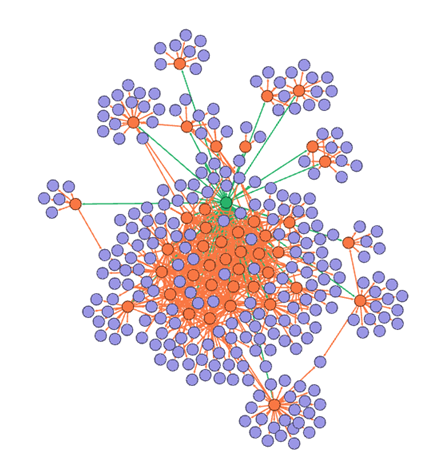
The sources we draw on are mostly lists of loosely connected publications, authors, and journals. The SDG turns them into a network, establishing connections not present in the sources.
We match manuscript authors to their prior publications, so a new submission can be contextualised against an author’s publication history and also to the journal’s other publications and manuscripts. We link every reference to the evaluated publication it cites, so a manuscript citing a problematic work is visible instantly. Because signals connect across the graph, patterns emerge at the journal, institution, or author level, patterns invisible on an article by article basis.
Your own graph, not just ours
Here’s the part I’m most excited about. Published research is only half the story. The other half is the manuscripts moving through a publisher’s submission system, data no public source has ever seen.
With access to the SDG, every publisher gets their own version of the graph: the full public scholarly record plus their private manuscript data. Manuscripts stay private, but gain the context of hundreds of millions of evaluated publications. Even more importantly, the publisher’s version of the graph gets richer with every submission, connecting manuscripts to authors, references, and each other in ways that weren’t possible before.
That combination of public record and private manuscripts, connected in a graph, is something truly unique.
What this unlocks
Two new features in Signals Manuscript Checks show what the combined graph makes possible.
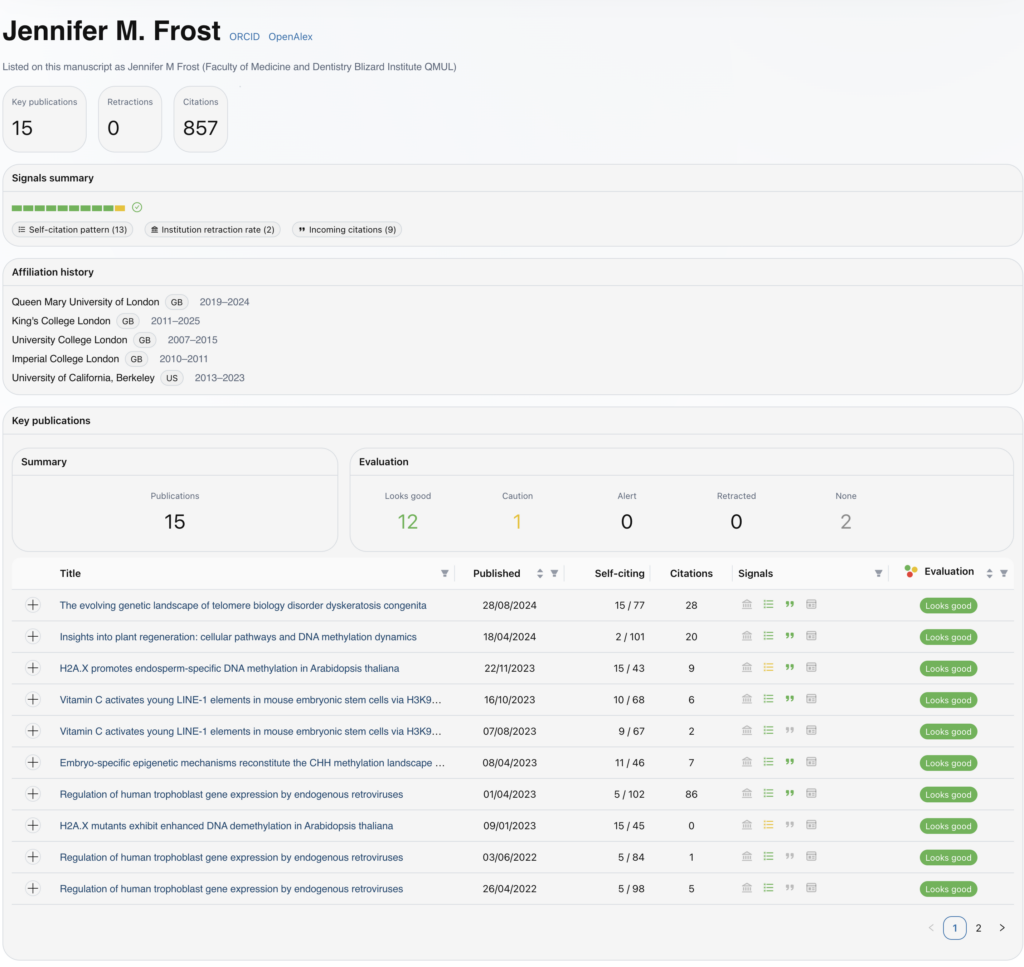
Manuscript Author Profiles. One click takes an editor from a manuscript report to a rich profile of each author: publication history, affiliations, citations, and a summary of signals across their body of work. We rigorously curate each profile to ensure publications are accurately attributed, significantly minimizing the risk of misidentification for authors, so that someone with a common name isn’t credited (or blamed) for someone else’s work. What used to be tedious, time-consuming search across databases is now readily available at the point of screening and decision making.
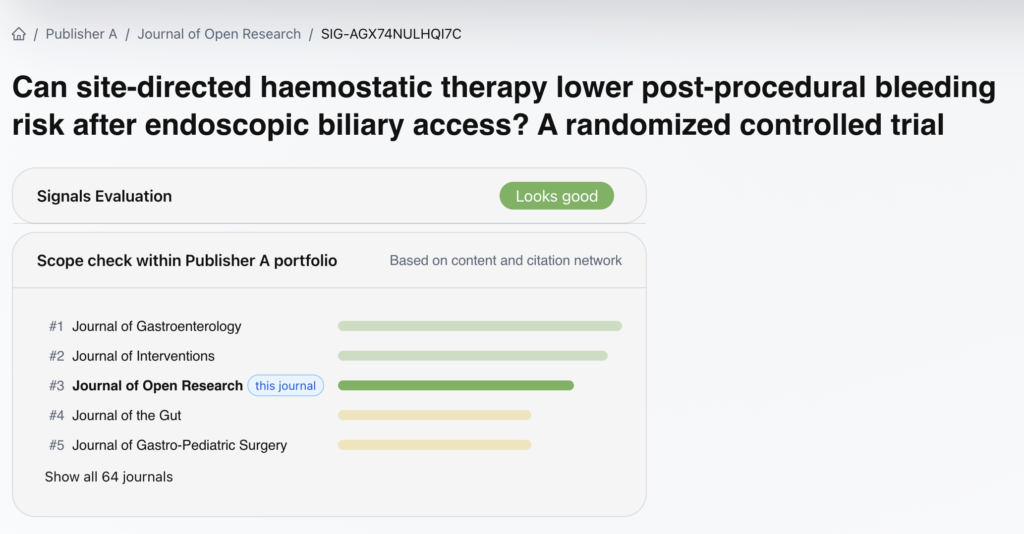
Scope check. Because a publisher’s graph holds both the manuscript and their full portfolio’s publication history, we can show editors how well a submission fits with their different journals, using that from past publications and recently submitted work. It’s a quick scope check that helps route manuscripts correctly, confirming the author’s choice or flagging a better transfer target.
Both features are rolling out to customers soon.
Want to see the SDG in your own portfolio? Book a demo or email hello@research-signals.com.